

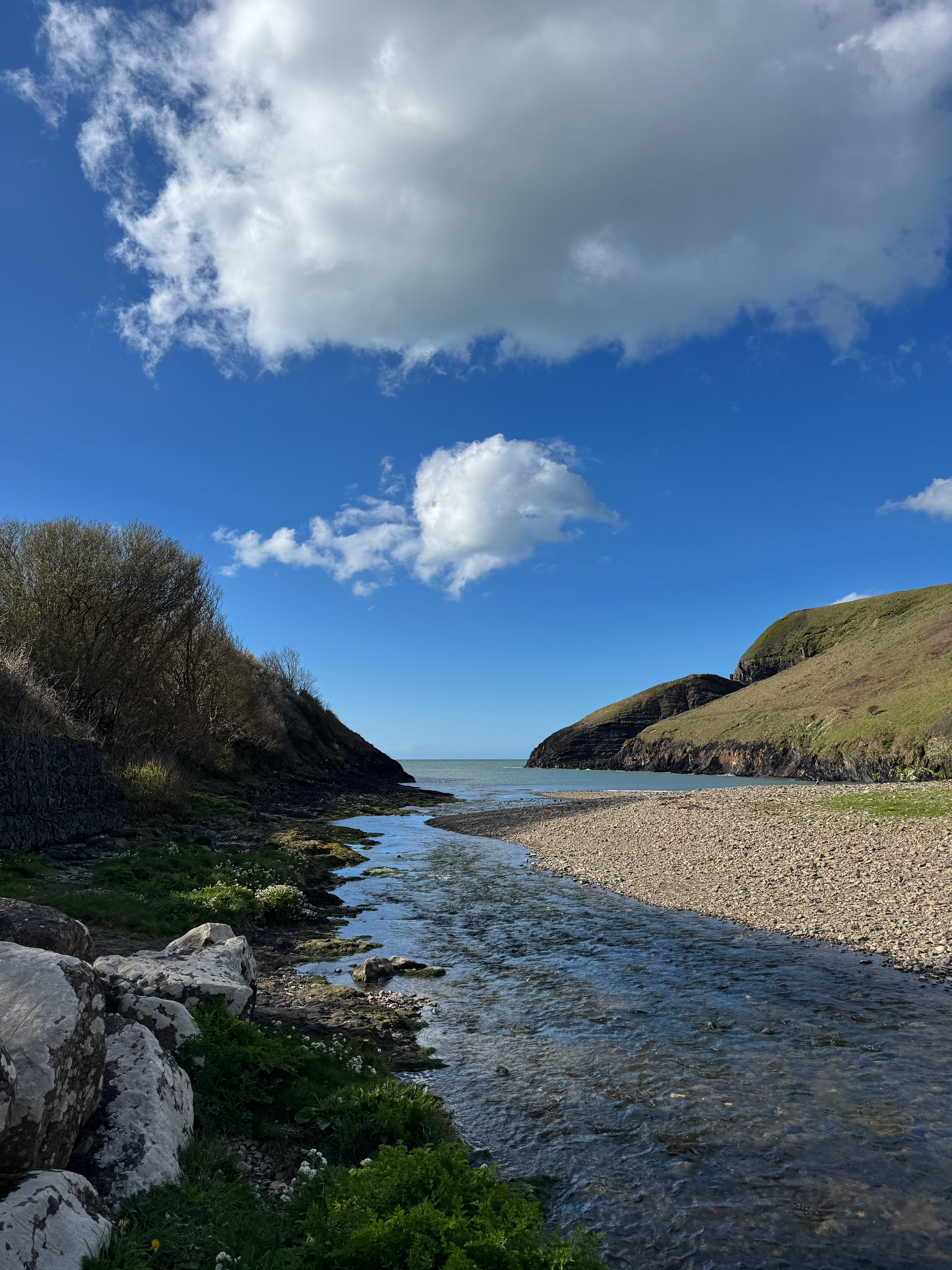
We were in the car on the way to Wales. I was driving, and my husband David was reading a story to our four-year-old daughter in the back, one of Harriet Muncaster’s Emerald books, about a mermaid princess.
The word horizon came up. “What’s the horizon?” she asked. There was a pause, and I felt my mind scramble for a good enough description. Some words about perspective, maybe, or the curvature of the earth. Meanwhile David simply looked out of the window and said: “It’s where the sky meets the land, or the sky meets the sea. It’s the furthest point you can see.”
Something in me stopped. I was struck by the purity of his description. How few words were needed to catch something so expansive. Nothing added, nothing interpreted, no attempt to explain what a horizon meant. Just: this is what I see.
There is something very powerful about being able to say what is appearing to us without immediately adding ourselves to it. This capacity has a name: distinguishing. To distinguish something is not the same as explaining it, analysing it, or even understanding it. It is closer to allowing the aliveness within our midst to become visible, and it is a uniquely human, and creative, act.
There is confusion here. There is fear. There is a horizon. There is a busy mind. There is silence. The words are not the thing itself. They are pointing towards what is here, in this moment. And this matters, because what is here is never persistent.
The word is not the thing.
— J. Krishnamurti
The horizon is a great example. There is no line laid across the earth called the horizon. Move your body and it moves, change where you are standing and a different horizon appears. What we see cannot be separated from where we are seeing from. This sounds obvious when we are talking about landscape, but becomes much less so when we are talking about ourselves.
The developmental psychologist Jean Piaget once asked a five-year-old boy what names were. The child answered, in essence, that names are what you see when you look at the world. We learn very early to experience the names we give things as though they belong to the things themselves. Tree. Mother. Good. Bad. Difficult. Successful. Anxious. Special. Me. Emma. Eventually we no longer experience ourselves as someone who has a name. The name becomes who we are. And something similar happens with almost everything else.
We distinguish constantly without knowing that we are distinguishing. We think we are simply perceiving reality. This is the difficult bit: our human assumption is that the world we experience is already there, fully formed, waiting for us to notice it. But life is far stranger. What appears to us is inseparable from the place from which we are looking.
Our history is looking. Our fears are looking. Our family culture is looking. Our expectations, desires, memories and assumptions are looking. The mind is continually generating a very convincing thought-about-world, and then quietly forgets that it has anything to do with its construction.
I have spent much of my life, both personal and professional, inside that thought-about-world. Psychotherapy quite rightly asks us to listen closely to it. To understand how our histories live inside us, how early relationships shape later ones, how patterns repeat across generations and how what cannot yet be thought often finds another way to speak. That work remains fundamental to me. But over the last several years another question has started to lead my life and my work.
Not only:
What happened?
Or:
Why am I like this?
But:
From where is reality being experienced?
It is a very different vantage point, and it changes the place from which the inquiry begins. Because once I can notice the thought-about-world as a thought-about-world, even momentarily, something loosens. The details may still be there. The old thoughts still move. The familiar emotional weather still passes through. But perhaps I no longer have to climb inside every thought and follow it all the way to the end.
I have started calling this disarming the mind: not silencing thought, but loosening our allegiance to everything it tells us. It is becoming a body of teaching in its own right, but it begins here, with noticing that thought and aliveness are not the same thing.
There is another way of being human. Not by transcending ordinary life, nor by silencing the mind, nor by trying to become some serene version of a person who no longer gets stressed in airports or caught in an argument or frightened by the future. More like remembering how to look out of the window. To notice what is here. To distinguish the appearing world, and to notice where I am looking from.
This is one of the places from which Field Therapy is beginning. You may have noticed the new name of my Substack; slowly, the different strands of my work are gathering under this name. Fieldtherapy.com is taking shape.
I have resisted naming it for a while. Partly because of my garden variety self-doubt, but mostly because the work itself has been developing across different disciplines — Psychotherapy, Maturation, Social Dreaming, Elemental Chi Kung — and every time ‘I’ try to capture it, the effort gets in the way of the life moving through the space that I happen to be. So I am not going to explain the whole thing yet. I want to let the language arrive at the same pace as I’m waking up to the field.
One thing I can say is this: Field Therapy begins with the possibility that the person we take ourselves to be and are heavily identified with is not the whole picture. That who we are, what we notice, what we fear, what we repeat and what appears possible to us emerge within fields far larger than an isolated individual mind. And that beneath all our human naming, interpreting and meaning-making, there remains an astonishing capacity to lean back from the noise of the mind and rejoin the flow of life.
The natural world teaches us this continually. At the height of summer it can be almost impossible to remember what the depth of winter feels like. And in November, when the trees are bare and the evenings close in before we’re ready, summer can feel like something we merely dreamt. Nothing has gone wrong of course, the world is simply moving. My study of the Five Elements in Chi Kung has taught me, over and over, that reality does not stay still long enough to become the thing I want to call it. And perhaps neither do I. The more deeply I enter this work, the less certain I become. Strangely, that feels like progress.
I have spent so much of my life asking how. How do I change this? How do I fix it? How do I understand it? How do I get from here to there? Increasingly, another question comes first.
What? What is here? What am I distinguishing? What is appearing? And from where am I seeing it?
For now, perhaps that is enough.
The horizon is where the sea appears to meet the sky.
Look again, and it has already moved.
◇
I am a UKCP-registered Psychotherapist, Group Analyst, Maturation Guide and Elemental Chi Kung Teacher, and the founder of Field Therapy: an emerging practice exploring what becomes possible when we loosen our grip on who we think we are.