

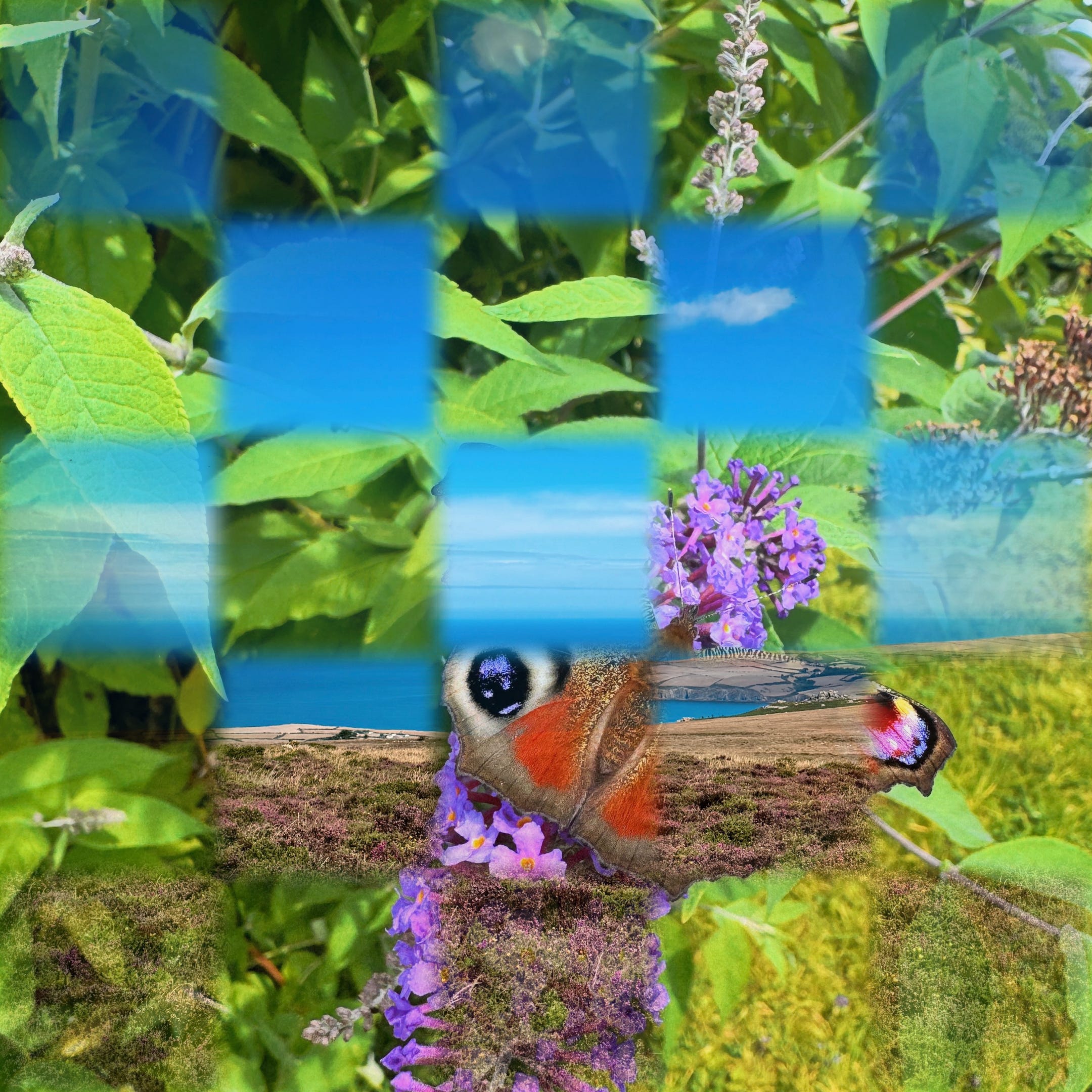
My husband keeps pointing out a problem. I have chosen to call the body of work I practice Field Therapy. He thinks people might imagine standing in an actual field. Which, to be fair, is not entirely off-brand. We spend a lot of time in the wilderness, and all my imagery is mountains and skies and trees.
But no, you don’t need more technical wear, and the Field I’m talking about isn’t something you can photograph. It is the larger, invisible context we are already participating in: our relationships, our family systems, our cultural conditioning, our microbiome, history, the natural world, and everything else that is given by this context without necessarily appearing in our awareness.
Human beings tend to experience themselves as separate units. I am in here, looking out at a world that is out there, and the mind is expert at maintaining this arrangement. It names, defines, and explains things, constructing a convincing account of who I am, who you are and what is happening between us. All very useful. Also not the whole story.
So let’s take a look at the difference between person and world, node and network, particle and field.
The word field has a serious history.
In physics, Michael Faraday began developing the idea of the field in the nineteenth century as a way of understanding forces acting through space. Rather than looking only at separate objects and what they do to each other, the field offered a way of thinking about the larger system of forces in which those objects exist.
By 1844, Faraday was entertaining the possibility that atoms might be “mere centres of forces or powers”1, rather than little pieces of matter with forces acting around them. Two years later, he wrote that “the particle indeed is supposed to exist only by these forces, and where they are it is.”2
It was a big reversal of perspective. Perhaps the field was not simply something surrounding matter. Perhaps what appeared to be the solid, separate thing could only be understood through the field, and, more radically, as secondary to the field itself.
Psychology made a similar move. Kurt Lewin’s Field Theory proposed that human behaviour could not be understood by looking at the person alone. His famous equation, B = f(P,E), described behaviour as a function of the person and their environment. Person and psychological environment together constitute the “life space”, an interdependent field. For Lewin, this interdependence was the “keynote of the field-theoretical approach.”3
This idea also runs through the therapeutic traditions I come from. In Group Analysis, Foulkes used the word matrix to name the network of relationships and communication in which individual psychological life takes place. In psychoanalysis, Madeleine and Willy Baranger described the analytic situation as a dynamic field created between analyst and analysand, shifting attention from two separate minds to what was being created between them.4 And let’s not forget Bion’s thoughts in search of a thinker. Later field theorists such as Antonino Ferro and Giuseppe Civitarese developed these ideas further.
Different disciplines, different meanings of the word, but a related shift in viewpoint: away from the isolated thing and towards the field in which it becomes what it is.
And this is where my own use of the Field begins.
As a first step, there is a distinction to make between being separate and being distinct. I am distinct from you. My body is not your body. My history is not your history. A tree is not a person and a person is not a group. But distinct does not mean separate. We are continually being shaped by, responding to and participating in what is around and between us. Relationship is not simply something that happens to an already finished person; it is how that person comes to be, and how they express themselves as a being.
This matters therapeutically, because so much of our suffering happens inside the assumption that the separate self we identify with is who we are. We become preoccupied with the contents of that self: my thoughts, my history, my patterns, my problems, my healing. There is nothing wrong with any of this, I have spent many years as a therapist working there. But another, and I believe more powerful, possibility appears when we stop placing our attention on the individual story and lean back into the wider context in which it is occurring.
This brings me to a word that is central to the work of Maturation: distinguishing.
To distinguish something is not simply to understand it. It is to catch yourself, in the moment, looking from a context that gave you the something in the first place.
A history, belief or wound can organise our whole experience and then we consistently forget that it is only one possible way of experiencing that moment as the reality we believe it to be.
Once distinguished, it doesn’t disappear, but it is no longer the only possible place to stand. This is the key movement I am always exploring through Field Therapy, and Dreamwork offers us a particularly good way in.
The night shift
Dreams are delightfully inconvenient to the rational mind. They don’t respect chronology at all. People become other people. You walk through your kitchen and arrive at the sea. The dead turn up. Animals speak. You can be terrified by a teacup and totally unconcerned that you’re flying.
Dreaming gives us an encounter with experience organised by a different logic, outside of space and time. And something even more interesting happens when we take dreams out of the private realm and put them into the realm of a group: the dreams begin to know things together.
Dreamweaving is my way of working with the Social Dreaming tradition.
Instead of asking:
What does my dream mean?
A new kind of question appears:
What might be surfacing here between us?
A dream about water is spoken into the group. Someone remembers the river from their own dream. Another person has an association to fast-flowing feelings. A colour returns. A bird appears from a childhood dream and reminds someone else of the bright feather they found that morning. Nobody needs to decide what the bird means. We follow the thread. Gradually, something begins to emerge out of the weaving.
For the first part of an online session, our cameras are off. We meet only through our voices. Dreams, fragments, images and associations enter the space without being quite so firmly attached to the particular person who brought them. After a while it becomes difficult to know where one person’s material ends and another’s begins. Themes repeat. Images echo each other. A symbol spoken by a stranger suddenly illuminates the nameless feeling you’re carrying without knowing you were carrying it. The Field unconceals itself.
We haven’t analysed our way there. We have listened our way there. And this, for me, is an experience of the Field: something becomes available between us that none of us knew alone, and none of us could have known in advance.
You don’t have to understand it
I can explain the structure of a Social Dreaming Matrix and tell you about Gordon Lawrence and its development at the Tavistock Institute. I could even share the flow of a recent Dreamweaving, but description falls short.
The Field is not interested in becoming an understandable concept. Neither are dreams. They are much more alive, and much better encountered.
Field Therapy asks: Where am I looking from?
Dreamweaving alters where we are able to look from.
This is part of what I am learning as Field Therapy takes shape. The last thing I’m trying to do is build another system of ideas for the mind to master. I am interested in creating conditions in which our habitual way of knowing relaxes enough for us to notice what else is here.
Chi Kung can do this as attention moves away from thought and into the non-verbal intelligence of the body.
A therapy group can do this as we distinguish the past permeating the present and suddenly lose the desire to get into the same old fight.
The wilderness can do this when we stop experiencing nature as something outside us and remember that we are wild nature through and through.
And dreams are exceptionally good at unlocking a view beyond the known self.
You don’t even need to remember one. You can simply participate in a Dreamweaving session by listening. And see what the Field dreams when none of us is trying quite so hard to know what it means.
The next chance to experience this is Wednesday 30 September ↓
7:00–8:30am · 90 minutes · Online · £11
◇
I am a UKCP-registered Psychotherapist, Group Analyst, Maturation Guide and Elemental Chi Kung Teacher, and the founder of Field Therapy: a practice exploring what becomes possible when we loosen our grip on who we think we are.
Faraday, M. (1844). “A Speculation Touching Electric Conduction and the Nature of Matter.” Philosophical Magazine, 24, 136–144.
Faraday, M. (1846). “Thoughts on Ray-Vibrations.” Philosophical Magazine, 28.
Lewin, K. (1951). Field Theory in Social Science: Selected Theoretical Papers. D. Cartwright (Ed.). New York: Harper & Brothers.
Baranger, M. & Baranger, W. (1961–62). “The Analytic Situation as a Dynamic Field.” International Journal of Psychoanalysis, 89(4), 795–826 (English translation published 2008).
Brilliant, Emma. Thanks....from my(the?!) field