

No energy in the world disappears. It transforms. At the most fundamental level, the universe is continuity: stars becoming elements, elements becoming bodies, bodies returning to earth, life endlessly cycling through different expressions of itself. We are absolutely part of that process. And so it follows that when we die, we don’t really go anywhere. We simply change shape.
When you look deeply into a cloud, you can see the rain, the river, the tea in your cup. The cloud has not died. It has become something else.
— Thich Nhat Hanh, No Death, No Fear
Contemplating this brings up the full experience of loss. The longing. The love. The missing. The resistance. But it also reminds us that we are an intrinsic part of the whole, even though we appear to be separate in our form. That’s just what the mind sees. Until the mind begins to develop the capacity to see itself: naming, defining, reducing, separating.
I’ve been listening to a lot of Adyashanti this year. I like his books, but I love the living quality of his talks, the way his words emerge in direct relationship to the moment itself. Again and again he returns to the mystery of conscious awareness and the tendency of the mind to carve reality into fixed pieces.
One example stays with me. The tree. Or what we call a tree. Within our limited framework, a tree appears to be a trunk, roots, branches and leaves. But of course there is no tree without the earth. There is no tree without the sky. Pull a tree out of the earth and it dies. Separate it from sunlight, weather and atmosphere and it weakens and perishes. The tree is as much the earth and the sky as it is bark, leaf and root. We are the ones who divide this wholeness. We are the ones whose minds separate in order to know.
But there are other ways of knowing. Other ways of living and being in relationship to one another and to the natural world. Many of those ways of knowing have been dominated, diminished, and in some cases destroyed by colonial power, capitalist structures, and the irrationality of scarcity that quickly becomes greed.
I’ve just read a beautiful paper by a fellow Group Analyst, Matthew Rich-Tolsma, exploring Afrikan knowledge systems and their relationship to Group Analysis.
Ubuntu reimagines the analytic field not as a collection of isolated psyches, but as a matrix of mutual becoming where recognition, repair, and justice are inseparable.1
Ubuntu is often translated as “a person is a person through other persons”, but its meaning runs far deeper than the proverb suggests. Ubuntu describes a relational way of being in which identity is not something we possess privately, but something that emerges through relationship. Human life is communal, unfinished, and continuously becoming.
Reading it, I found myself wondering whether this is exactly what Adyashanti is pointing towards through the image of the tree. Not simply that we depend upon one another, but that the boundaries we imagine between self and world are far more porous than we realise. The tree appears separate, but cannot exist apart from earth, sky, rain, sunlight, insects, fungi, and time. In the same way, perhaps there is no such thing as an isolated human being. Perhaps there is only life expressing itself in particular forms.
And yet, paradoxically, Ubuntu does not dissolve individuality. One of the things I loved most in Matthew’s paper was the description of interdependence-with-difference. The self exists through relationship, but each person remains irreducible. We belong to the whole, and at the same time we are each of us unique, and uniquely valuable.
The reason I’m in this territory at all is because I found myself returning to the mystery of life and death a lot this month. What it means to be an ordinary person with a personality, a history, a body, and a life. And somehow, so much more than that. Not only the life moving through me now, but the life that will continue to move when this particular form called Emma completes and returns to dust.
I found myself thinking about all of us in this great circular dance. Our ancestors. Our children. Those who came before us and those who will come after. Life continuously changing shape across millennia. And then, somewhere inside that vastness, a moment of wonder arrived.
There is only one of you, once.
A particular moment in time. A particular body. A unique set of circumstances. What I’m describing is different to the idea that you only live once, because I suspect life is doing something far stranger than that. It’s the emphasis that there is only one version of this particular expression.
Only one you. Once.
So what is the song that only you can sing? What is the path that only you can walk? What is the unique expression that life is trying to bring into the world through the particular shape that it is taking as you?
I seem to be able to write. I usually find it effortless. Enjoyable. And most importantly in this mad overstimulated era, it’s one of the gentlest ways I know to connect with another human being.
Through writing, when you are ready and choose to read, I reach out to you. And perhaps you can feel me there. Not just my ideas or the particular words on the page, but my presence. My life is a devotion to this movement between form and formlessness.
I teach Elemental Chi Kung so that I, and others, can enter into relationship with the Chi, which is the connecting force of the universe, the space between things that aren’t really separate.
I facilitate groups where inherited patterns, family histories, and transgenerational wounds become visible enough to be met. It is profound relational work, but at its heart it is an encounter with the unseen, surfacing into consciousness the deep, historical undercurrents that drive our lives, so we can release their grip.
I listen for the rise of the thought-about world, and call my clients into awareness that nothing is happening to them, although it feels very real. When this begins to land, we start to see the traumatised one within us who, in a confusion between past and present, is simultaneously generating the experience we are suffering from. It’s not easy to receive this kind of mirror, but it disarms the mind, and creates a new set of possibilities.
Increasingly, my own pathway is deepening through ritual, ceremony, altered states, and non-ordinary perception, and slowly taking shape into a new kind of holding for others.
I sense that this calling is in part fuelled by my heritage. Malta is a tiny island with a vast history. A place shaped by invasion, occupation, resilience and prayer. A place that holds some of the oldest megalithic temples in the world. Within my bones I find an inheritance that feels older than language, an in-built relationship to mystery, and the unseen. We all carry this, of course, but we have forgotten how to remember. So in some ways I’m here to help us stay awake to the separating movement of the mind, and rediscover the deeper intelligence we were born with.
Recently I stepped into a relationship with Amanita Muscaria, microdosing as part of my ongoing commitment to plant teachers. I am not looking for answers. I am devoted to listening beyond the limits of my form, while staying real about the complexity of having a physical body in the human domain. Something about the detail of our personal stories is becoming less central to my worldview. I’m not attached to analysis and certainty and understanding like I used to be. I’m more interested in participating. Unlearning. Watching. Allowing life to come to me.
This emptiness, more beautiful than existence,
it obliterates existence, and yet when it comes,
existence thrives and creates more existence.
— Rumi, Bouyancy
If there is only one of us, once, then perhaps our task is sovereignty. To become intimate with and committed to the particular shape that life has taken as us, and then find ways to contribute, no matter how small. Freedom of expression requires us to outgrow self-abandonment, and embrace a kind of radical self-listening. Counter-intuitively, when we come from that place our capacity to care for others and make positive impact in the world multiplies rather than contracts. We learn to create the conditions to be of service.
And so, just as I invite you to turn towards your centre, and let it lead, I have my own frequency to nurture and most importantly, share. Which is why I’m writing about Amanita here, and my experience of being in close proximity to this teacher over the course of one month. Let me give you a glimpse.
First and foremost, she is a nervous system tonic. An anchor in the unforgiving seas of life. Initially, she spoke through my dreams, showing me the landscape of her Black Forest home, and folding me into her fairy tale matrix.
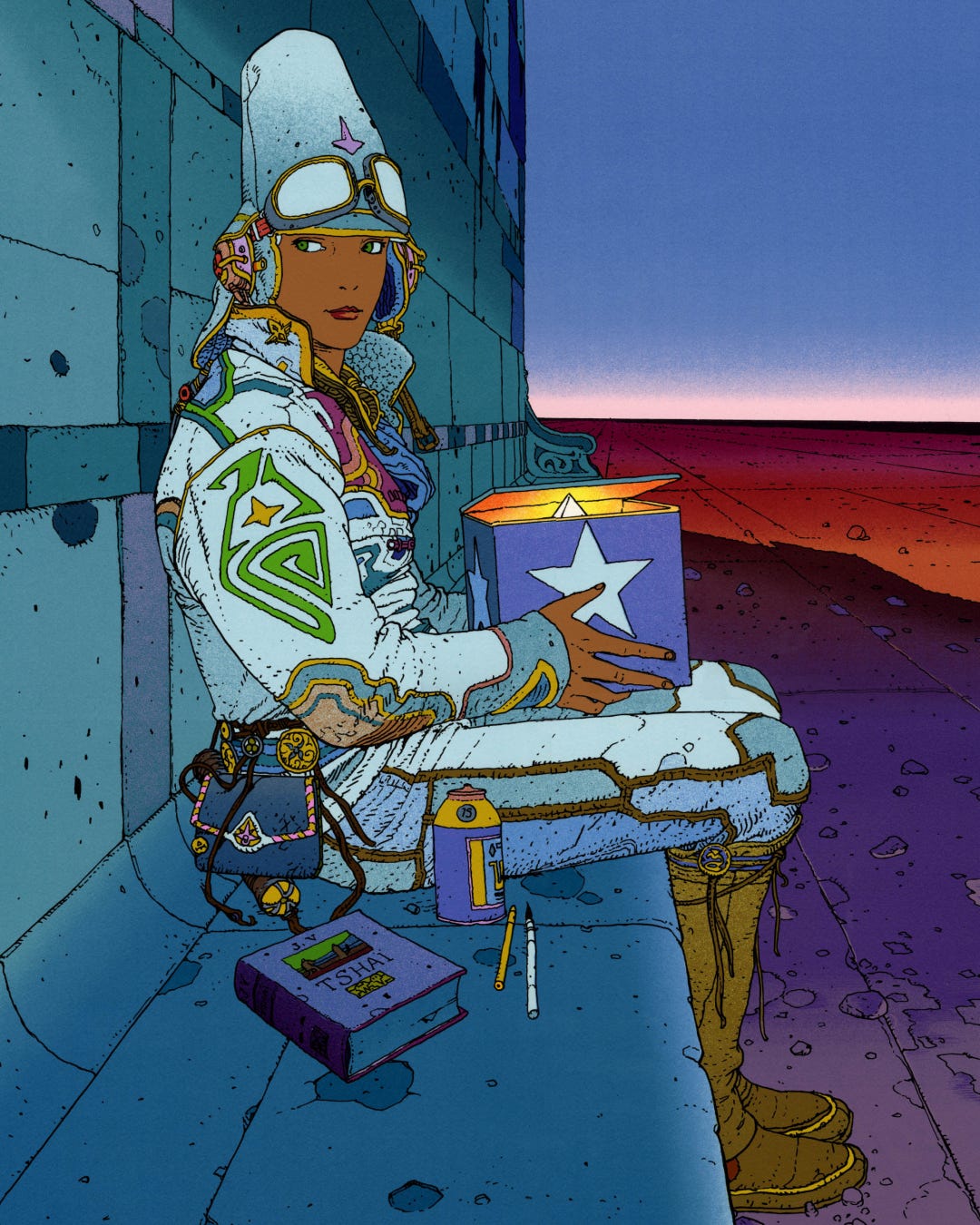
As the month went on, I realised the subtle power of the shift she was creating within me: Amanita was helping me to remember lantern consciousness, where awareness is wide and diffuse and soft and open. Like a child. Less attached to content, details, and meaning making, I discovered myself in a renewed relationship to time. All is here for a moment, and our intimacy with that moment is transformational.
It wasn’t all light, she also brought the falling away of Autumn, and the solitude of Winter too. I felt the ache of surrender right in my heart, and my tears and sadness flowed often, but I also found myself choosing and trusting that edge of ending, no longer fearing it.
And now in the echo of that month of deep work, there is some big re-alignment taking place in my life as I realise, quite simply, that I need more support in order to expand in the way that my calling requires.
I will return to her guidance at some point, but for now, from my lived experience, I can tell you that I appreciate Amanita’s still, steady language so much, and her strange nighttime glow. She has placed me on the cusp of the sacred, where I am finally beginning to recognise the shape of the master teachers and let them speak. What a doorway.
◇
I am a UKCP-registered Psychotherapist, Group Analyst, BodyMind Maturation Guide, and Elemental Chi Kung Teacher exploring non-dual wisdom, the intelligence of dreams, altered states and the relational field of human experience.
Rich-Tolsma, M. (2026). Reckoning with inheritance: Decolonising group analysis through Afrikan knowledge systems. European Journal of Psychotherapy & Counselling.